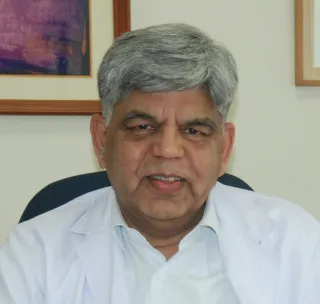
Prof. Amod Gupta

Emeritus Professor, Advanced Eye Centre, Post Graduate Institute of Medical Education and Research,Chandigarh -160012

7 articles

Professor Amod Gupta was a professor of Ophthalmology at the Post Graduate Institute of Medical Education and Research, Chandigarh (India) and currently the Professor emeritus of Ophthalmology, Government of Punjab. He was the Dean at the PGI from 2010 to 2014. He headed the department of Ophthalmology at the PGI from 1989 to 2015. He raised the Advanced Eye Centre in 2006, one of the most advanced ophthalmic centres for patient care, training and research in India. More recently, with a competitive research grant of Rs 5.00 crore by the DBT, he set up a Centre of excellence for study of intraocular inflammations at the Advanced Eye Centre, PGI. He has been at the forefront of clinical research in Ophthalmology and especially in the field of retinal and uveal diseases. In the last nearly 25 years, his contributions have been outstanding in discovering new diseases, their clinical manifestations and new management strategies which have brought about paradigm shift in the management of several blinding diseases. His researches have been recognized internationally. A passionate teacher and researcher, he has published 377 original research papers in national and international journals which have been extensively cited (6404 Scopus. H index of 40). His coauthored books on ‘Optical Coherence Tomography’, ‘Diabetic Retinopathy’ and “Uveitis: Text and Imaging” are read all over the world. In the early 1990’s, he first introduced the use of high technology in eye care in North India and was the first person to start Vitreo-retinal surgery in the entire North India for hitherto incurable retinal diseases. He was also elected the President of Vitreo-retinal society of India. He pioneered the setting up of the subspecialty of Uveitis and Intraocular inflammations in India and was the founder President of the Uveitis Society of India. He is an acknowledged international leader in Ocular tuberculosis and was elected to the most prestigious the International Uveitis Study Group. He has worked extensively on intraocular tuberculosis and described a new disease entity, ‘Tubercular Serpiginouslike Choroiditis’ now recognized world over and successfully treated thereby preventing blindness from this hitherto incurable disease. He discovered contaminated glucose infusions in rural settings as a previously unknown risk factor for developing fungal endophthalmitis in otherwise healthy young individuals. His work on the use of atorvastatin in the management of diabetic maculopathy is extensively cited in the contemporary literature and provided initial evidence for recommending statins in patients with diabetic retinopathy. In view of his outstanding contributions in Ophthalmology, he was awarded the first R N Mathur award(1996) and Dr P Siva Reddy International Award (2008) by the All India Ophthalmological Society, Chandigarh Ophthalmological society (A D Grover Memorial oration,1999), Ahmedabad Academy of Ophthalmology (Cash award of Rs1.00lac,2000), Gold Medals by the All Assam Ophthalmological Society (1996), Haryana Ophthalmology Academy(2004), Bombay Ophthalmological Association(2011), Bangalore Ophthalmological Society (Life time achievement award,2013), Punjab Ophthalmological Society (Dr Daljit Singh oration, 2005) Jharkhand Ophthalmological Society, (B P Kashyap memorial oration,2006), Andhra Pradesh Ophthalmological Society (P Siva Reddy Award-2011), Asia Pacific Academy of Ophthalmology(Distinguished Service Award 2007) American Academy of Ophthalmology (Achievement Award-2009) , Ranbaxy Research Foundation (Ranbaxy Research award- clinical research 2008), Cochin Ophthalmic Club (Prof T Gopinatha Menon memorial oration and Gold medal 2011), RK Seth Memorial oration (Delhi-2011), First B Patnaik memorial oration (Vitreo-retinal society of India-2011), TNC Vedantham memorial oration (Radhatri Netralaya, Chennai,2013) Prof M K Mehra oration of KGMC, Lucknow (2014), Dr Anila Khuteta memorial oration of Rajasthan Ophthalmological Society(2014) and “Teacher of Teachers Award-2012” by LVP Eye Institute, Hyderabad and “Teacher of Teachers Award- 2015” by Center for Sight, New Delhi. He delivered the first Dr. SS Grewal oration of North Zone Ophthalmological Society in Oct 2015. He was also elected Fellow of National Academy of Medical Sciences (FAMS-2006) and delivered the prestigious VR Khanolkar oration (2007-08). Recently, he was honored by German Ophthalmological Society with ‘von Szily Medal and lecture-2015’. He was nominated fellow of Panjab University by the Vice President of India (2016-2010) . He delivered Dr JL Sharma Oration of the Eye7 group of hospitals, Gurgaon in 2016, Dr. G Venkataswamy Endowment lecture and medal of Uveitis Society of India 2017, Dr. MC Luthra oration of the Drishti Eye Institute, Dehradun 2018, Padma Shri Dr. Dhanwant Singh Oration of the Ludhiana Ophthalmological Society, 2018 and Prof A N Pandey oration of Bihar Ophthalmological Society, 2018 As a recognition of his unique personal achievements, he was awarded the Padma Shri (2014), the fourth highest civilian award in India, by the President of India.


  1. Pinned Interesting Reads 25 Jan 2025 8 min read

    Primer for a Novice Researcher

    1.Steps before starting your research journey: Choose a broad area in your discipline (Ophthalmology) that fascinates you. Medical rather than surgical disciplines offer more research opportunities. Know that inflammations of the uvea and retinal diseases offer immense opportunities for interdisciplinary research. Get cross-disciplinary training to gain insight into disease epidemiology, etiopathogenesis, and management. Dr J.D.M. Gass, the father of the modern medical retina, and Prof Narsing Rao trained in pathology and ophthalmology. Likewise, Dr. Jim Rosenbaum trained in rheumatology and immunology and did pioneering research in uveitis. Drs. Robert Nussenblatt and Manabu Mochizuki were trained in both immunology and ophthalmology. Drs. John Kempen and Emmett Cunningham were trained in public health and ophthalmology. Many other researchers like them who trained in more than one discipline also became world leaders in their respective fields. Attend a course in research methodology

  2. Interesting Reads 7 Feb 2022 7 min read

    Ten Lessons I Learnt from My Patients

    Greet your patients by their name: As the patient enters your chamber, always greet the patient by his first or last name. It has a magical effect on gaining their trust. The patients remember their doctors but the doctor remembering the patient is a very big deal. This is especially true for those practicing in busy referral institutes in metropolitan cities. Whenever I addressed them by their name, I saw them getting visibly relaxed. Even If they had been waiting long hours for their turn, frowns on their face simply melted away as I called them by their name. Mind how you address your patients: Old people are extremely sensitive to how they are addressed. They may not like to be addressed “Mother”, “uncle” or “aunty”. I learnt it the hard way when I addressed a middle-aged lady Mata Ji (mother) and she brusquely told me that she was younger than me. Learn communication skills: You may greet the patients as they come in, but always ask the patient and the accompanying person to sit b

  3. Articles 1 Apr 2021 13 min read

    Ocular Tuberculosis

    Ocular involvement in TB has been recognized for a long time and was first described in 17111. The spectrum of tuberculosis (TB)-related uveitis is wide. Its diagnosis still remains a challenge due to the lack of uniformity in the diagnostic criteria along with difficulties encountered in confirming the diagnosis by the laboratory methods available. It is a major concern in countries endemic for TB, and intraocular TB is being increasingly reported from various regions2-4. The true prevalence of intraocular TB is not known in India. While it has been reported to be 0.39% in South India, it is much higher (9.86%) in North India1,5. Varying rates of its prevalence have been reported from the world over (0.5% in the U.S.A., 6.31% in Italy, 6.9% in Japan, and 10.5% in Saudi Arabia). The largest series of patients with presumed intraocular TB and their outcome has been recently reported from our center6. Pathogenesis Uveitis due to latent TB has been reported since long. However, their exac

  4. Interesting Reads 1 Apr 2021 10 min read

    Publish or Perish

    The catch phrase ‘Publish or perish’ among the scientific community to mean ‘either publish your research or lose your job’ is a constant threat that hangs like a Damocles’ sword on their heads. ‘Publish or perish’ also signifies the reality and pressures for progress of science in the world of academia that is becoming hugely competitive. In an increasingly connected and globalized world, nobody, located in how so ever remote an institution, can claim to be untouched by this menace. Why do science? Science is altruistic, it is selfless without any motive except gaining recognition for the person doing it or the institution or the lab where the science is being done. There are no immediate personal financial gains for the scientists except that recognition in the peer group nationally and internationally is an award itself. It also facilitates easier acceptance of future grants for the individual scientists and the institutions from various funding agencies. What is science? Science is

  5. Articles 1 Apr 2021 2 min read

    Ten Pearls for Treatment of TB Uveitis

    1. In TB-endemic countries, think of TB as a probable/possible etiology of uveitis in Presence of one or a few large full-thickness choroidal granulomas that show enhanced vascularity/RAP on FFA Retinal periphlebitis with subvascular retinitis/choroiditis lesions/scars that show extensive peripheral retinal ischemia. Multifocal serpiginoid choroiditis/Serpiginous-like choroiditis lesions with vitreous cells. 2. In the presence of any of the above clinical phenotypes, collect evidence of MTB infection by way of tuberculin skin test/QuantiFERON-TB Gold; X-ray/CT chest. The 2-step testing (Bayesian probability) improves the likelihood of MTB as a probable/possible etiology of uveitis in TB-endemic regions. 3. Polymerase chain reaction to detect MTB DNA from ocular fluids has low sensitivity limiting its utility in clinical practice. If positive, it confirms the diagnosis of TBU but a negative test does not rule out MTB. 4. Start 4-drug anti-TB drug regimen in consultation with an internis

  6. Articles 5 Apr 2020 15 min read

    Retinal Vasculitis

    Retinal vasculitis is an inflammatory disease of the blood vessels of the retina that may be associated with primary ocular conditions or with inflammatory or infectious diseases in other parts of the body (systemic diseases). It has been defined as the vascular leakage and staining of vessel walls on fluorescein angiography, with or without the clinical appearance of fluffy, white perivascular infiltrates in an eye with evidence of inflammatory cells in the vitreous body or aqueous humor 1. Typically, retinal vasculitis is divided into entities localized to the retina and into systemic diseases involving the eye. These include certain ocular disorders, systemic autoimmune disorders, and some infectious diseases. Etiology: The common primary causes of retinal vasculitis where vessel is the primary target of the inflammatory process are: (a) Localized to the eye - Idiopathic - Intermediate uveitis of the pars planitis type - Frosted branch angiitis - Idiopathic retinal vasculitis, aneur

  7. Blog 21 Feb 2020 13 min read

    "Powerpoint presentations can be a good resource for a refresher course but never for primary learning": Prof. Amod Gupta

    eOphtha: You have been a teacher for more than 3 decades. You have seen the transition from bed side teaching to teaching which predominantly hinges on a power point presentation. Your thoughts on it. Answer: Very interesting question at a time when ppt. presentations hold sway in the class room and the conference hall. There is no way a ppt. slide can substitute a bedside/clinical exam. For us in Ophthalmology ‘the bedside’ is ‘the slit lamp side’. When you examine a patient on the slit lamp, each step in the exam is preceded by a question in our mind, do I see flare? Do I see Iris atrophy? Or do I see new vessels in the angle? When you discover what you are seeking it forms a long lasting memory. Seeing the same sign on a power point slide is a passive phenomenon like watching a movie, in that it is an information in the first place you are not actually seeking, and this unsolicited information is likely to be lost sooner than later. Certainly, sign seen on a ppt. slide can be a quic