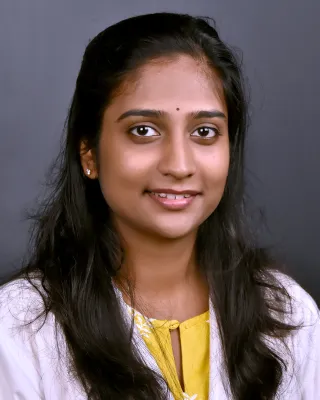

Dr. Varshitha Hemanth Vasanthapuram

Consultant, Ocular Oncology, Oculoplasty & Orbit service, Narayana Nethralaya, Bangalore, India, Email: vivavarsh@gmail.com

1 article

Dr. Varshitha completed her MBBS from Vijayanagar Institute of Medical Sciences, Bellary and post-graduate training in Ophthalmology from the prestigious Post Graduate Institute of Medical Education and Research (PGIMER), Chandigarh. She further did long term Fellowship in Ophthalmic Plastic surgery, Orbit, Dacryology and Ocular Oncology from LV Prasad Eye Institute, India from 2018-2019 and continued working as a Consultant for one year in the LVPEI network.During her under-graduation, she won the Best paper award at the National Conference on Students Medical Research conducted at Government Medical College Trivandrum. She has won prizes at various national level quiz competitions during post-graduation and received the Bronze medal in MD examination in 2017. Dr. Vasanthapuram has presented many research papers at International, National and Regional conferences. She has publications in peer-review journals and a few book chapters. She has special interest in pursuing research in Thyroid Eye Disease and imaging specific to eyelid. Her hobbies include painting, sketching, crafting, cooking and travelling.

  1. Articles 21 Apr 2021 16 min read

    Facial Spasms: Diagnosis and Management

    Introduction Dystonia is defined as a movement disorder characterized by sustained or intermittent muscle contractions causing abnormal, often repetitive, movements, postures, or both [1]. They may be isolated or combined with other neurological symptoms or movement disorders [1]. Dystonia is classified based on the age of onset, etiology, clinical features, and body distribution. The body distribution may be either focal, segmental, multifocal, generalized, or hemi-dystonia. Only one region of the body is affected by focal dystonia. It emerges in late adulthood [1]. Patients with movement disorders isolated to the facial region often visit an Ophthalmologist. A brief knowledge about the identification and differentiation of the various facial movement disorders is essential. The disorder can be functionally or socially distressing to the patients. The facial movement disorders include orbicularis myokymia, Benign Essential Blepharospasm (BEB), Apraxia of Lid Opening (ALO), Hemifacial