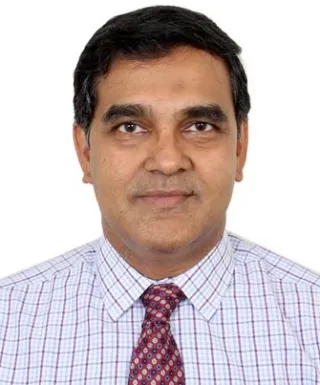

Dr. Murali Ariga

Chennai

1 article

Dr Murali Ariga is in Ophthalmic practice at Chennai with special interests in Glaucoma, Cataract, Phaco with premium IOLs, Refractive surgery and Lasers. Present posts 1. Director and Senior Consultant, Swamy Eye Clinic and Chennai Glaucoma Foundation 2. Head, Dept of Ophthalmology, Sundaram Medical Foundation (a TVS group hospital) 3. Director Research & Head, Glaucoma Services, M N Eye hospitals, Chennai 4. DNB Faculty and Teacher, MN College of Optometry, Chennai 5. Editor-in-Chief, Glaucoma Newsletter, Glaucoma Society of India 6. Associate Editor, Journal of Tamilnadu Ophthalmic Association 7. Member-Scientist, MN Eye hospitals Institutional Ethics Committee Qualifications MBBS (Madras Medical College) MS (Ophthalmology) M& J Western RIO, Ahmedabad, Gujarat DNB - Diplomate of the National Board (Ophthalmology) FAICO (Glaucoma) Collegium of All India Ophthalmic Society University first in MS (ophthalmology), Gujarat University, 1993 Subspecialty training and experience: 1. Observer with Prof Ravi Thomas, Schell Eye hospital, CMC Vellore 2. Observer with Prof Robert Ritch, New York Eye and Ear infirmary, USA 3. SNEC Singapore for LASIK training 4. M N Eye hospital 1year Community Ophthalmology fellowship He has more than 30 publications in peer reviewed journals, CDs on Automated perimetry and Videos on Trabeculectomy (ICGS), Chapters in Dr Ramakrishnan's Textbook on glaucoma, Recent advances in ophthalmology (JPB), ICGS Textbook of Glaucoma Surgery and Chapters in the AIOS ready reckoner 2010 and 2016. He has edited a book Practical Perimetry which was published by JPB in 2016. He has made numerous presentations at national and international meetings such as AAO, ARVO, ASCRS and WGC. Best scientific presentation award for 'Pharmacoeconomics of glaucoma medication' at the GSI meeting in Chandigarh in 2008. FAICO (glaucoma) at the APAO AIOS 2013. Video titled 'Surgical management of challenging glaucomas' has been ranked among the top 10 videos at AIOS Agra, 2014. Paper on Ocular blood flow was presented at the AIOC Top innovations session in AIOC Jaipur 2017 and a Chapter on the same subject is published in Recent advances in Ophthalmology 14, Jaypee Publications. He was involved in glaucoma research in the CURES (Chennai urban rural epidemiological survey) study at Dr Mohans Diabetes research center 2004-06 and is also the principal investigator in many ongoing multi-center clinical trials in India. He had been Member Scientific Committee, SROC 2003 and TNOA 2015. He was Treasurer of the Glaucoma society of India from 2008-10. Dr Murali has also been on the Expert panel (glaucoma) of the AIOS scientific committee group in 2013, Project leader for the TNOA ARC program in glaucoma 2012-13 and has organized several Glaucoma India Education programs (GIEPs) across the country. Public glaucoma awareness programs during the World glaucoma week every year including a human chain involving 1000 participants at the Elliots beach in Chennai and Glaucoma awareness cycling rallies in 2017.

  1. Articles 1 Apr 2021 3 min read

    Five things you should know about Micropulse LASER in Glaucoma Management

    Glaucoma is a leading cause of irreversible blindness worldwide, with more than 70 million people affected. Traditionally treatment options include topical medications, laser trabeculoplasty, incisional surgeries, glaucoma drainage implants (GDD), and cycloablative procedures. GDD and ciliary body destruction is generally reserved for refractory or end-stage glaucoma in eyes with poor visual potential. Transscleral cyclophotocoagulation (TSCPC) Transscleral cyclophotocoagulation (TSCPC) is a cyclodestructive procedure designed to target the melanin in the pigmented ciliary body epithelium, thereby decreasing the rate of aqueous humor production. Numerous studies have confirmed the IOP-lowering ability of TSCPC and also reported the risk of developing serious complications with this procedure, such as persistent ocular inflammation, vision loss, hypotony, phthisis bulbi, and rarely sympathetic ophthalmia. Therefore, TSCPC, which conventionally uses the continuous-wave diode laser, has b