

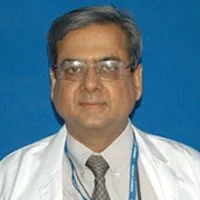
Dr. Jyotirmay Biswas

Sankara Nethralaya, Chennai

4 articles

Dr Jyotirmay Biswas is an ophthalmologist who has specialized in uveitis and ophthalmic pathology. He has done MBBS from Medical College, Calcutta and post graduation in ophthalmology from PGIMER, Chandigarh, fellowship in vitreoretinal surgery from Sankara Nethralaya. He did two years fellowship in ophthalmic pathology from Doheny Eye Institute, University of Southern California, USA. He has published 417 articles in peer reviewed pubmed indexed journals, 47 chapters in books of ophthalmology. He presented 32 papers in international conferences and 175 papers in national and state conferences. He had given 400 lectures in international and national conferences. He had 3 books on Uveitis and one book of ophthalmic pathology. He is reviewer of 36 Journals. He is a visiting professor at Advance Eye Care Center at PGIMER Chandigarh and Chinese University of Hongkong. He was the principal investigator of 13 research projects. He has mentored 43 uveitis fellows from India, Bangladesh, Indonesia and Kenya. He has received 34 awards which includes Hari OM Ashram Award for clinical research from Medical Council of India. He is a member of International Uveitis Study Group. American Uveitis Society and executive council member of International Ocular Inflammation Society. He is the founding member and past President of Uveitis Society of India. He was the first to describe ocular lesions in AIDS in India. His current areas of research include uveitis, AIDS and Eales’ disease. Currently he is working as director of uveitis and ophthalmic pathology departments at Sankara Nethralaya, Chennai. Dr Biswas also a marathon runner, recites Bengali poems and writes Bengali articles and received many awards for that.

  1. Students Gallery 5 Apr 2020 8 min read

    How to Write a Case Report

    ‘Science only advances when unexpected observations cause a frame shift in our previously held beliefs’. Karl Popper Case reports are the best ways to start publishing and it can be a valuable tool for both the author and the reader. Though there are numerous ways for medical writing; case reports are the best ways to start publishing. From Hippocrates (460B.C. to 370 B.C.) to modern-day practice, physicians of all specialties have described interesting cases in their fields. [1], [2] More than 240000 case reports have been published in various journals from 1997-2002 as per Medline report. [3] Case reports have also been used as a teaching tool. Acquired Immunodeficiency Syndrome (AIDS) and Parkinson’s disease were first described in case study format. [4], [5] Retinopathy of prematurity (ROP) was originally described as Retrolental fibroplasia by Terry [6] in 1952, who related it with premature birth. Even though case reports are not the best scientific evidence still many authors be
  2. Blog 14 Mar 2020 17 min read

    The Lost Goat and One Ophthalmologist

    After joining the medical profession, almost all doctors came to know that apart from treating a patient, he has to give sympathetic answers to all the queries that arise deep down in the hearts of the patients. These questions according to cricket terminology, come to you as “good length” or “too wide”. You have to listen carefully, patiently, and answer. After finishing the questionnaire, he can ask the same question once again. Don’t feel bad about that. After the patient has finished asking questions, the patient’s wife will again ask the same questions separately, then the patient’s uncle and then the patient’s cousin, who had come with him but was all along standing outside puffing at a cigarette or had gone out to have tea, will come back and ask the same questions. After that, the patient will find out somebody, who is known to the doctor and through him will ask the same questions about a week later. He may ask the same questions while having ice-cream together with you having

  3. Blog 14 Mar 2020 5 min read

    How to Present a Scientific Paper

    It's true that Computer is indeed a boon to a scientist making a presentation. Yet it is important that the presenter himself is adequately prepared for a good presentation. He needs to plan carefully and follow a few basic steps. A good scientific presentation starts from the time a paper is conceived. If you want to present a good paper, ensure that the concept is good, well thought, designed aptly, results well analysed and valid conclusions are made. You should have your ground work done and write the draft of the paper, before embarking on a presentation. A well-written draft will provide the frame work of a good presentation. Your work starts as soon as you hear that the paper has been accepted. After acceptance, you need to plan the slides, the slide text and rehearsals to fine-tune the talk. How many slides do you need? - It depends on your presentation. For an eight minute presentation it is ideal to have seven pairs or 11 to 12 pairs at the maximum, assuming each slide will t

  4. Blog 14 Mar 2020 7 min read

    An Autobiography of an Unknown Uveitis Specialist

    I know autobiography is usually written by great man e. g a great leader, president of a country, political leaders, a great sportsman, especially a cricketer, even a CBI director, or election commissioner. The great Nirod C Chowdhury wrote an autobigraphy of an unknown Indian. These autobiographies often disclose startling facts, relationships which sometimes cause real uproar in the society. Actually such controversies increase the sale of the book. I thought of writing this memoir not to raise any controversy or preach anything. To the best of my knowledge an autobiography has never been written by an uveitis specialist. Probably their life has often remained within haze of flare or cells in the fluid in the anterior chamber of the eye or in the vitreous cavity. In the year 1987 I became a consultant. Instead of becoming a vitreoretinal surgeon, I became the specialist (supposed to be) after fellowship in the vitreoretinal surgery to not that area rather little closer to it, which i